Domestic Helper Annual Leave in Hong Kong: Days, Pay, and Rules
How many days of paid annual leave a Hong Kong domestic helper gets, how to work out annual leave pay, notice rules, and what to pay when a contract ends.

Helpers Philippines
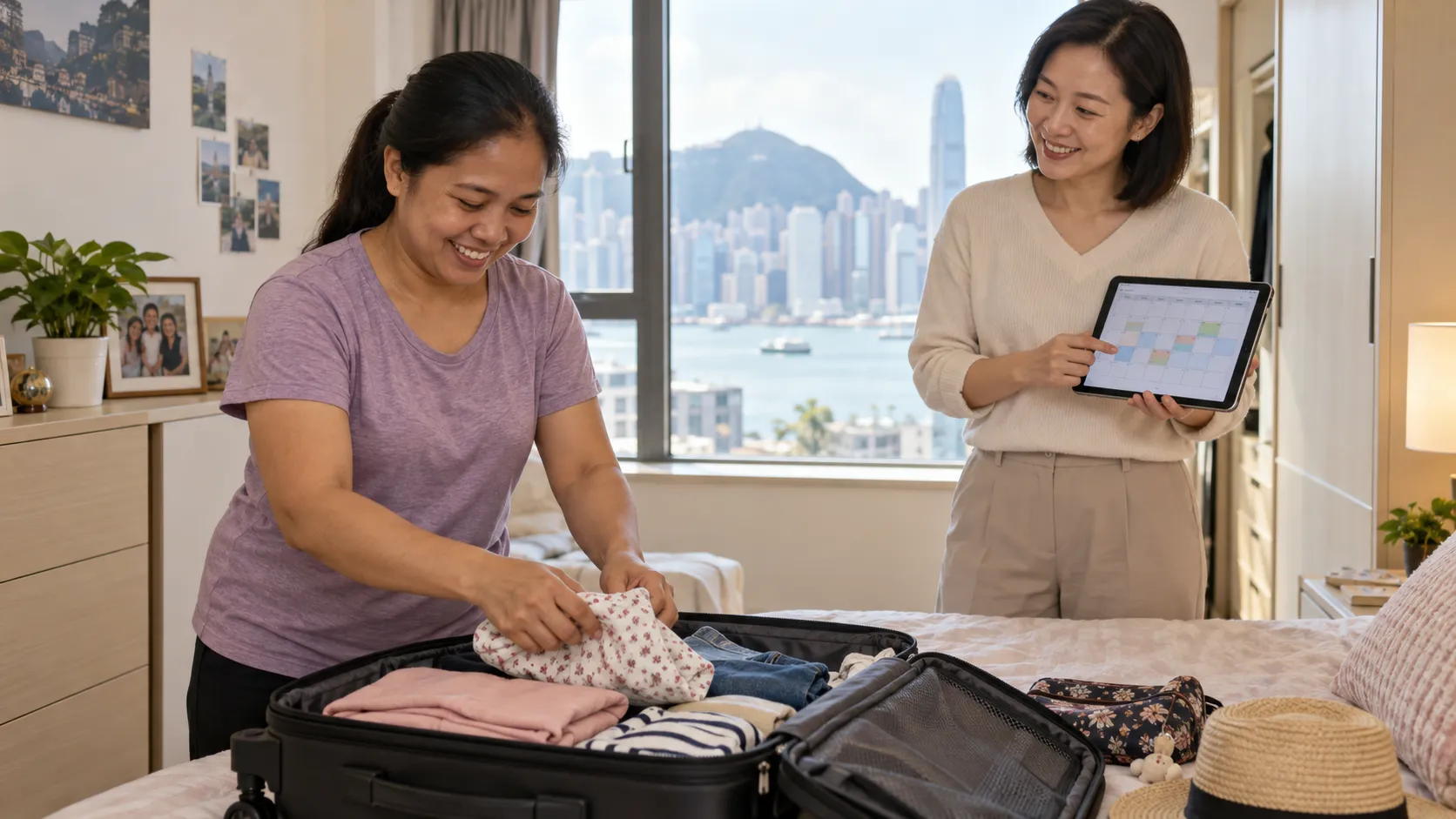
Direct answer: Under the Employment Ordinance, a foreign domestic helper in Hong Kong earns 7 days of paid annual leave after each of the first two years with the same employer, rising by one day a year to a maximum of 14 days after 9 years. You pick the dates after talking with your helper and confirm them in writing at least 14 days ahead. Each leave day is paid at the helper's average daily wages over the previous 12 months, and any leave not taken must be paid out when the contract ends.
This guide is for Hong Kong families who employ a foreign domestic helper on the ID 407 Standard Employment Contract. It covers the leave scale, how to set dates, how to work out the pay, what to pay at termination, and how annual leave differs from the home leave you arrange when you renew. Every rule here comes from the Labour Department and the Immigration Department. Check the linked pages before you rely on a figure, because the government updates them.
How many days of annual leave a domestic helper gets
Annual leave depends on length of service with you. Your helper earns it after every 12 months of employment under a continuous contract, and the number of days grows with each year. The Labour Department's Concise Guide to the Employment Ordinance, Chapter 4 sets out this scale:
| Year of service completed | Paid annual leave earned | Must be taken within |
|---|---|---|
| 1 | 7 days | the following 12 months |
| 2 | 7 days | the following 12 months |
| 3 | 8 days | the following 12 months |
| 4 | 9 days | the following 12 months |
| 5 | 10 days | the following 12 months |
| 6 | 11 days | the following 12 months |
| 7 | 12 days | the following 12 months |
| 8 | 13 days | the following 12 months |
| 9 or more | 14 days | the following 12 months |
A helper on her first two-year contract with you earns 7 days at the end of month 12 and another 7 days at the end of month 24. If you renew, she earns 8 days at the end of year 3, and so on. After 10 years of service, the entitlement stays at 14 days a year.
The scale follows length of service under a continuous contract. If you renewed with the same helper and there was a gap between contracts, ask the Labour Department whether that service counts as continuous before you rely on the higher figure.
When annual leave is earned and when it must be taken
The Employment Ordinance uses a "leave year". This is each 12-month period that starts on the day the employment began, and on each anniversary of that day. If your helper started on 1 March, her leave year runs from 1 March to the last day of February.
Two rules follow from this:
- Leave is earned at the end of each completed leave year. Your helper has no statutory right to paid annual leave during her first 12 months, although you can agree to give leave earlier.
- The leave earned must be taken within the following 12 months. Leave earned at the end of year 1 should be used during year 2.
Some employers prefer a "common leave year" such as the calendar year. The Concise Guide allows this, but you must give one month's notice first, in writing to your helper or by posting a notice. Leave for the part year before the switch is worked out pro rata, and any fraction of a day counts as a full day. In the Labour Department's example, a worker who started on 1 September in a calendar leave year gets 122 / 365 x 7 = 2.34 days, rounded up to 3 days. With one helper, the anniversary-based leave year needs no notice and no pro rata step.
Who decides the dates and how much notice to give
You, as the employer, appoint the dates of annual leave. You must first consult your helper, then confirm the dates by written notice at least 14 days in advance. A shorter notice period is allowed only if you both agree to it.
Annual leave should be one unbroken block. If your helper asks to split it, the Concise Guide permits this:
- With an entitlement of 10 days or fewer, up to 3 days can be taken separately and the rest must be taken in one block.
- With an entitlement of more than 10 days, at least 7 days must be taken in one block.
The split is at the helper's request. You cannot break the leave into single days to suit your schedule.
The Labour Department's handbook for foreign domestic helpers also says a helper should never be required to work during rest days, holidays, or leave. Asking her to clean the flat before she leaves or wash the dishes when she returns counts as work. If your helper stays in your home during her annual leave, the days are still hers.
A practical way to agree dates:
- Ask your helper which weeks she wants, for example a family event in the Philippines or Indonesia.
- Check them against school holidays and your own travel.
- Agree the dates in person.
- Send a short written notice with the start date, end date, and number of leave days, at least 14 days ahead.
- Keep a copy signed by both of you.
How to calculate annual leave pay
Annual leave pay uses the 12-month average wage method set out in Appendix 1 of the Concise Guide. These rules have applied since 13 July 2007.
The daily rate of annual leave pay is the average daily wages your helper earned in the 12 months before a "specified date":
- For a single day of leave, the specified date is that day.
- For more than one consecutive day, it is the first day of the leave.
- For untaken leave paid out at termination, it is the date the contract ends.
If your helper has worked for you less than 12 months before the specified date, use the shorter period instead.
To find the average, divide the wages earned in the 12-month period by the number of days in it. Before you divide, take out any days for which your helper was not paid, or not paid in full, together with the money paid for those days. Examples are unpaid leave you agreed to, or a sick day paid at four-fifths. Fully paid rest days, statutory holidays, and earlier annual leave do not need to be taken out.
"Wages" has a defined meaning in the Employment Ordinance. It includes money paid for work, including allowances, but excludes the value of food or accommodation you provide in kind. If you pay a cash food allowance or any other extra, check with the Labour Department whether it belongs in the average.
You must pay annual leave pay no later than your normal pay day after the leave ends.
A worked example
This is a hypothetical example to show the arithmetic. It is not advice on what any helper should be paid.
Assume your helper earns HK$5,220 a month, the Minimum Allowable Wage for contracts signed on or after 3 October 2026, according to the Labour Department's foreign domestic helpers FAQ. A helper on an older contract will be on the wage written in her contract, which may be lower. Assume she was paid the same wage for all of the last 12 months, with fully paid rest days and holidays and no unpaid leave.
- Wages in the 12 months before the leave: 12 x HK$5,220 = HK$62,640.
- Days in the period: 365 (366 if the period includes 29 February).
- Days and money to take out: none.
- Average daily wages: HK$62,640 / 365 = HK$171.62.
- Pay for 7 days of annual leave: HK$62,640 / 365 x 7 = HK$1,201.32.
For a helper paid the same monthly wage all year, the leave days come out at the same daily rate as her normal wage. The arithmetic matters most when her wage changed in the last 12 months, for example after a renewal at a higher wage, or when she took unpaid or part-paid leave. In those cases, work the figure out from your payment records. The Labour Department's Statutory Employment Entitlements Reference Calculator lets you check your result.
Show the leave days, the daily rate, and the total on the payslip or receipt so your helper can see how you reached the number.
Paying untaken annual leave when the contract ends
When an ID 407 contract ends, early or at expiry, annual leave pay is part of the final settlement. The Labour Department FAQ lists payment in lieu of untaken annual leave, and pro rata leave pay for the current leave year, among the usual termination payments.
The Concise Guide sets out these cases:
| Situation at termination | Annual leave payment |
|---|---|
| Less than 3 months of service | Nil |
| 3 to 12 months of service, summary dismissal for serious misconduct | Nil |
| 3 to 12 months of service, resignation or dismissal other than summary dismissal | Current year entitlement x days employed / 365 |
| 12 months or more, less than 3 months into the current leave year | Untaken leave from the previous leave year |
| 12 months or more, 3 to 12 months into the current leave year, summary dismissal | Untaken leave from the previous leave year only |
| 12 months or more, 3 to 12 months into the current leave year, resignation or other dismissal | Untaken leave from the previous leave year, plus current year entitlement x days employed in the current leave year / 365 |
Untaken leave already earned is always paid, whatever the reason the contract ends. Only the pro rata part depends on how it ends.
The handbook gives an example. A helper who resigns or is dismissed after 18 months, and who has taken no annual leave, gets 7 days for the first 12 months plus 3.5 days pro rata for the remaining 6 months. If the same helper is summarily dismissed for serious misconduct, she gets the 7 days only.
Each day is paid at the average daily wage for the 12 months before the termination date. Using the hypothetical HK$5,220 wage from the example above, 10.5 days comes to HK$62,640 / 365 x 10.5 = HK$1,801.97.
Other termination payments, such as one month's notice or wages in lieu, outstanding wages, and the return passage, are separate items. Pay by bank transfer where you can so there is a record, and have your helper sign a receipt that lists each item. The Labour Department FAQ links to a sample receipt for this purpose. Both of you must also notify the Immigration Department within 7 days of an early termination, as the ID 407 contract terms explain.
Rest days, statutory holidays, and sick days during annual leave
Annual leave sits alongside your helper's other leave. It does not replace any of it.
Rest days and statutory holidays inside a leave period. The Concise Guide says any rest day or statutory holiday falling within a period of annual leave "will be counted as annual leave and another rest day or holiday must be appointed". In practice, your helper does not lose the rest day or holiday. If her 7 days of leave include a Sunday rest day and a public holiday, you give her another rest day and another holiday on other dates. Plan leave around the 2027 statutory holidays so you can see which days overlap.
Cash instead of leave. Your helper may choose to accept payment instead of the part of her annual leave entitlement above 10 days. That only arises from year 6 onwards, when the entitlement reaches 11 days. Leave up to 10 days must be taken as time off. Statutory holidays work differently: you can never pay your helper instead of granting a statutory holiday.
Sick days. Sickness allowance is a separate entitlement under the Employment Ordinance, paid at four-fifths of average daily wages for sick leave of at least 4 consecutive days backed by a medical certificate. The Concise Guide does not say what happens if your helper falls sick during her annual leave. If this comes up, call the Labour Department's labour relations enquiry line on 2717 1771 before you decide how to record the days.
Penalties. An employer who fails without reasonable excuse to grant annual leave, or who fails to pay annual leave pay, is liable on conviction to a fine of HK$50,000, according to the Concise Guide. Failing to grant the leave and failing to pay for it are listed as separate offences, each with that maximum.
Home leave under the ID 407 contract is a separate entitlement
Families often mix up annual leave and home leave. They come from different documents and work differently.
Annual leave comes from the Employment Ordinance. It is earned each year, scaled by service, and must be paid.
Home leave comes from Clause 13 of the ID 407 Standard Employment Contract. If you and your helper agree to a new contract when the current one expires, she returns to her place of origin for a vacation of at least 7 days before the new contract starts. The Immigration Department's foreign domestic helpers page says you pay the return fare. The ID 407 contract terms state that this vacation is in addition to statutory annual leave. The Labour Department handbook adds that whether the home leave is paid or unpaid depends on your agreement with your helper.
You can defer home leave in some cases. With mutual agreement, your helper can apply to the Director of Immigration for an extension of stay, normally of no more than one year, and take the vacation later in the new contract.
Return passage is a third item. Under the ID 407 contract, you provide free return passage to your helper's place of origin when the contract is completed or terminated. The Labour Department advises giving an air ticket with basic checked luggage rather than cash.
A simple way to keep them apart:
| Item | Source | When it arises | Paid? |
|---|---|---|---|
| Annual leave | Employment Ordinance | Every completed year of service | Yes, at average daily wages |
| Home leave | ID 407, Clause 13 | Between two contracts with the same employer | Paid or unpaid, as agreed |
| Return passage | ID 407 | Contract completed or terminated | Employer pays the travel |
Do not count home leave days against annual leave. If your helper has annual leave left when a contract ends and you renew, either agree dates for it or pay it out in the final settlement.
Keeping annual leave records
The Employment Ordinance requires every employer to keep a wage and employment record for each employee covering the past 12 months. Under the full Concise Guide, the record must include periods of annual leave, sick leave, and holidays entitled and taken, with details of the payments made for them. You must keep it for six months after the employment ends. Failing to keep the record can lead to a fine of HK$10,000.
For a helper, a simple record covers most of what you need:
- Start date of employment and the leave year it creates
- Leave earned at each anniversary, using the scale above
- Each written leave notice, signed by both of you
- Dates of leave taken and leave still owed
- Any replacement rest day or holiday given for days that fell inside the leave
- Annual leave pay for each period, with the daily rate and the date paid
- Wage receipts signed by your helper
The Labour Department's FDH portal has sample leave records in several languages. The handbook advises helpers to keep their own copies too, and to sign only records they understand and agree with. Give your helper a copy each time. Matching records on both sides make the final settlement easier to agree.
For the wider set of employment terms, see our guide to domestic helper salary, contract, and rights in Hong Kong. Filipino helpers checking their own position can read Filipino domestic helper rights in Hong Kong.
Frequently Asked Questions
How many days of annual leave does a domestic helper get in Hong Kong?
A foreign domestic helper earns 7 days of paid annual leave after each of the first two years of service with the same employer. The entitlement then rises by one day a year, to 8 days after year 3 and up to a maximum of 14 days after 9 or more years.
How is annual leave pay calculated for a domestic helper?
Each day of annual leave is paid at the helper's average daily wages over the 12 months before the first day of the leave. Add up the wages earned in that period, divide by the number of days, and leave out any unpaid or part-paid days and the money paid for them. Pay it no later than the next normal pay day after the leave.
Can I pay my helper cash instead of giving annual leave?
Only for the part of the entitlement above 10 days, and only if the helper chooses to accept payment. A helper with 10 days or fewer must take the leave. Statutory holidays can never be bought out.
What happens to untaken annual leave when the contract ends?
The employer pays the helper for any annual leave earned and not taken, whatever the reason for termination. A helper with 3 to 12 months of service in the current leave year also gets pro rata leave pay, unless summarily dismissed for serious misconduct. The daily rate uses the 12 months before the termination date.
Is home leave the same as annual leave for a domestic helper?
No. Under Clause 13 of the ID 407 contract, a helper who renews with the same employer returns home for a vacation of at least 7 days before the new contract starts, with the employer paying the return fare. The Immigration Department says this vacation is in addition to statutory annual leave. Whether it is paid or unpaid depends on your agreement.
A practical next step for families
Write your helper's start date, current leave year, and leave owed on one page this week, and agree the next block of annual leave with 14 days' written notice. If you are hiring, set out the leave and rest-day arrangements before you sign the ID 407 contract. Read more in Helpers' family guides, see the Hong Kong market page, and create a family account when your household brief is ready.
Sources checked for this guide
- A Concise Guide to the Employment Ordinance, Chapter 4: Rest Days, Holidays and Leave (Hong Kong Labour Department; accessed 2026-10-16)
- Appendix 1: Calculation of Relevant Statutory Entitlements on the Basis of the 12-Month Average Wages (Hong Kong Labour Department; accessed 2026-10-16)
- A Concise Guide to the Employment Ordinance (full guide) (Hong Kong Labour Department; accessed 2026-10-16)
- Foreign Domestic Helpers FAQ (Hong Kong Labour Department; accessed 2026-10-16)
- Be Prepared for Employment in Hong Kong: A Handbook for Foreign Domestic Helpers (Hong Kong Labour Department; accessed 2026-10-16)
- Standard Employment Contract and Terms of Employment for Helpers (Hong Kong Immigration Department; accessed 2026-10-16)
- Foreign Domestic Helpers (Hong Kong Immigration Department; accessed 2026-10-16)
- Statutory Employment Entitlements Reference Calculator (Hong Kong Labour Department; accessed 2026-10-16)
Last editorial review: 2026-10-16. Sources and regulated claims can change; confirm the current position before acting.
Related Guides
Maid Insurance Singapore: MOM Requirements and How to Choose
What maid insurance in Singapore must cover under MOM rules: S$60,000 medical cover, the 25% co-payment, personal accident cover, the S$5,000 bond and more.


Singapore Maid Levy: Rates, Concession, and How to Pay
Current MOM maid levy rates for 2026, who qualifies for the S$60 MDW levy concession, how GIRO billing works, late penalties, and levy waivers.

Statutory Holidays 2027 for Domestic Helpers in Hong Kong
All 15 Hong Kong statutory holidays for 2027, how they differ from public holidays, holiday pay, rest-day clashes, and the rules for working on a holiday.