5S of Housekeeping: Sort, Set, Shine, Standardize, Sustain
The 5S of housekeeping explained for Filipino helpers and hotel staff, with home and hotel examples, a 5S checklist, 7S variants, and where 5S appears in TESDA NC II.

Helpers Philippines
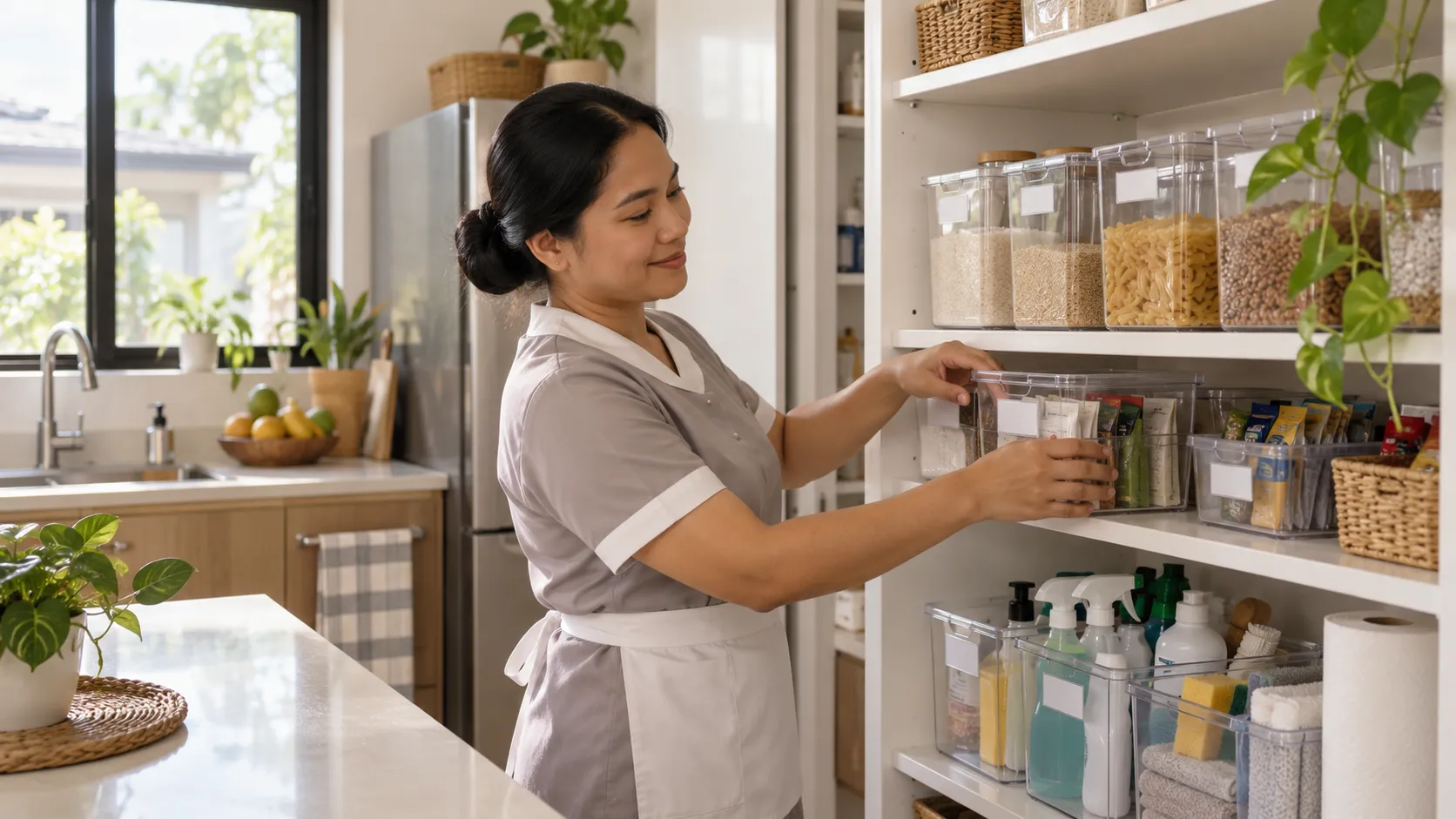
Direct answer: The 5S of housekeeping are Sort (seiri), Set in order (seiton), Shine (seiso), Standardize (seiketsu), and Sustain (shitsuke). You remove what you do not need, give every item a fixed place, clean and inspect the area, write the routine down, and keep checking it. In a Filipino home or a hotel, 5S keeps the kitchen, laundry area, cleaning closet, and guest rooms orderly between cleanings, and TESDA lists it in both Housekeeping NC II and Domestic Work NC II.
Most articles about 5S are written for factories and offices. You may be studying for TESDA Housekeeping NC II, working as a kasambahay, or cleaning hotel rooms. This guide explains each S in plain words, then shows how it works in a home kitchen, a laundry area, a cleaning closet, a child's room, and a hotel floor. It also covers 7S, a 30-minute reset routine, red tags, labels, shadow boards, and how to keep 5S going when the house belongs to your employer.
What the 5S of housekeeping mean
5S comes from Japanese workplace practice. Each word starts with "s" in Japanese, and English trainers picked English words that also start with "s". The Lean Enterprise Institute lexicon lists these five standard steps.
| S | Japanese | What you do | Simple test |
|---|---|---|---|
| 1. Sort | Seiri | Separate what is needed from what is not, and remove the rest | Is everything here used in this area? |
| 2. Set in order | Seiton | Give each remaining item a fixed, labelled place near where you use it | Can you find any tool in under 30 seconds? |
| 3. Shine | Seiso | Clean the area and inspect it while you clean | Would you notice a leak, crack, or broken item today? |
| 4. Standardize | Seiketsu | Write the routine so anyone does Sort, Set, and Shine the same way | Is there a checklist another person could follow? |
| 5. Sustain | Shitsuke | Keep the discipline with regular checks and small corrections | Does the area still look right after two weeks? |
The order matters. If you clean before you sort, you spend time wiping items that should leave the room. If you set things in order but never write a standard, the next person puts the mop back in a different corner.
5S is not a deep clean. A deep clean happens once. 5S changes where things live and how the household returns them, so daily cleaning gets faster.
Sort, set in order, shine: the first three steps in detail
Sort (seiri)
Take everything out of one small area. Put each item into one of three groups:
- Keep here. Used in this area at least weekly.
- Keep elsewhere. Still useful, but belongs in another room or storage.
- Ask or remove. Broken, expired, duplicate, or unknown.
In a private home, you do not own the items. Never throw away anything that belongs to the family without asking. Put the "ask or remove" items in a box, write the date on it, and show it to your employer. This is the household version of the red-tag method, explained below.
Check expiry dates on food, medicine, and cleaning chemicals while you sort. Keep chemicals in their original labelled containers.
Set in order (seiton)
Put each item where the work happens. Detergent goes near the washing machine. Pot holders hang next to the stove. Toilet brushes stay in the bathroom, never in the kitchen.
Three rules help:
- Heavy items low, light items high.
- Daily items at waist or eye level. Monthly items on top shelves.
- One place per item, marked with a label, outline, or photo.
Shine (seiso)
Clean the area, then inspect it. Shine is also checking. While you wipe a shelf, you see a rusted hinge. While you clean under the sink, you find a slow leak. Report problems the same day instead of cleaning around them.
Standardize and sustain: how 5S lasts
Standardize (seiketsu)
Write down what "clean and orderly" means for each area. Keep it short. A good standard fits on one page and uses pictures where possible. A photo of the finished cleaning closet, taped inside the door, works better than a paragraph.
A standard answers four questions:
- What gets done?
- How often (daily, weekly, monthly)?
- Who does it?
- What does "done" look like?
Sustain (shitsuke)
Sustain is the hardest step. Without it, the area slowly returns to clutter. Build small checks into your week: a two-minute look at each zone before you rest, a weekly walk-through with the checklist, and a monthly re-sort of one area. When a label falls off or an item has no home, fix it the same day.
The 7S of good housekeeping and other variants
You will see 6S and 7S in modules, slides, and job posts. These are extensions of the same five steps.
The Lean Enterprise Institute notes that some practitioners add Safety as a sixth S. Safety means you set up and follow safe procedures while you sort, store, and clean. Examples include storing bleach away from acids, keeping walkways clear, and using gloves with harsh chemicals.
The seventh S is less consistent. Some guides, such as this 7S explainer from Weever, list Security as the seventh S. Other trainers and companies use Spirit (team attitude) or System instead. No single official list exists.
If your trainer, school, or hotel uses 7S, ask which words they assess and use their version in your answers and on your resume. The first five steps stay the same in every version.
Where 5S appears in TESDA and DOLE guidance
TESDA Housekeeping NC II
The TESDA Housekeeping NC II training regulations (amended, promulgated December 2013) belong to the tourism sector. Under the unit "Perform workplace and safety practices", the evidence guide lists "5S Implementation" as required knowledge, next to garbage disposal and safety measures. The competency map in the same document includes practising housekeeping procedures (5S) as a basic competency. If you take this course, expect your assessor to ask how you apply 5S in a guest room, linen room, or public area.
TESDA Domestic Work NC II
The TESDA Domestic Work NC II training regulations (SOCDOW222, promulgated May 2022) mention 5S in two places:
- In the common competency "Maintain an effective relationship with client/customer", the performance criteria include keeping the visible work area tidy and uncluttered and storing equipment according to assignment requirements. The required knowledge lists 5S under environment control, together with proper waste management and reduce, re-use, re-cycle.
- In the basic competencies, "5S procedures and concepts" appears as required knowledge for implementing cost-effective operations.
So 5S is part of what a household assessor can check, not only a hotel topic. For the full differences between the two courses, read the Housekeeping NC II vs Domestic Work NC II guide. To confirm a school is registered for the qualification, use the TESDA registered-provider search.
DOLE Occupational Safety and Health Standards
The Occupational Safety and Health Standards, published by the DOLE Occupational Safety and Health Center (OSHC), do not use the term 5S. They do set the same idea for workplaces. Rule 1060.01, item 4, of the OSH Standards states: "Good housekeeping shall be maintained at all times." The rule names cleanliness of buildings, machines, and equipment, regular waste disposal, and orderly storage. Another section says storage areas must stay free of materials that create tripping, fire, explosion, or pest hazards.
These standards cover establishments such as hotels, resorts, and offices. In hotel housekeeping, 5S is one practical way to meet them. In a private home, the Batas Kasambahay and your employment contract govern your work. The same safety habits still protect you and the family.
How to apply 5S in a Filipino home
Start small. Pick one zone, finish all five steps, and show your employer the result before moving on. A finished cleaning closet convinces more than a half-sorted house.
Kitchen
- Sort. Remove expired condiments, broken containers, lids with no matching container, and duplicate utensils. Put them in the "ask" box for your employer.
- Set in order. Group by use. Cooking oils, salt, and soy sauce go near the stove. Plates go near the dish rack. Label shelves for rice, canned goods, and snacks.
- Shine. Wipe shelves, degrease the range hood filter, and check under the sink for leaks.
- Standardize. Tape a one-page list inside a cabinet: daily wipe-down, weekly fridge check, monthly pantry re-sort.
- Sustain. Rotate older stock to the front when you put away groceries (first in, first out).
Laundry area
- Sort. Remove empty detergent bottles, single socks left for months, and broken hangers.
- Set in order. Keep detergent, fabric conditioner, and stain remover on one shelf above the machine. Use separate labelled baskets for whites, colours, delicates, and items to iron.
- Shine. Clean the washing machine filter and lint trap, and wipe the drum seal.
- Standardize. Post the family's laundry rules, such as which clothes go to the dryer and which are hand-washed.
- Sustain. Empty baskets at the same time each day so laundry does not pile up.
Cleaning closet and shadow board
A shadow board is a board or wall where each tool has a painted or taped outline. When a tool is missing, the empty shape shows it at once.
To make one for cleaning tools:
- Mount a pegboard or a row of hooks on a wall near the closet.
- Hang the broom, dustpan, mop, squeegee, and scrub brushes.
- Trace each tool's outline with marker or coloured tape.
- Label each outline with the tool's name and the area it belongs to, such as "Bathroom brush" or "Kitchen mop".
- Store chemicals on a separate shelf, out of children's reach, never above food.
Use colour codes for cloths if the family agrees. For example, one colour for the bathroom and another for the kitchen, so cloths never cross between toilet and food areas.
Children's rooms
Children can do a simple 5S too. Use clear bins with picture labels for toys, books, and art supplies. Keep a "give away" box for outgrown clothes, and let the parents decide what leaves. A five-minute pick-up before bedtime is a child-sized version of Sustain.
5S in hotel housekeeping
Hotels already work with standards: room checklists, par stock on carts, and inspection by a supervisor. 5S fits these systems.
- Housekeeping cart. Every amenity and chemical has a fixed spot on the cart. Restock to par at the end of each shift.
- Linen room. Shelves labelled by size and type. Damaged or stained linen is set aside in a marked bin for the supervisor.
- Guest room. Follow the property's room standard in the same order each time, for example working from top to bottom.
- Public areas. Cleaning signs, mops, and caddies return to one marked storage spot after each round.
When you apply for hotel work, give a concrete 5S example in your interview, such as how you reorganised a linen shelf or cart. The housekeeper job description guide lists common duties to compare against.
A 5S checklist you can use today
Copy this checklist into a notebook or tape it inside a closet door. Tick each line during your weekly walk-through.
| Area | Sort | Set in order | Shine | Standardize | Sustain |
|---|---|---|---|---|---|
| Kitchen | No expired food or broken items on shelves | Shelves labelled, daily items at eye level | Counters, stove, sink clean and dry | Daily and weekly list posted | Groceries rotated, list checked weekly |
| Laundry area | No empty bottles or broken hangers | Labelled baskets, supplies on one shelf | Machine filter and lint trap cleaned | Family laundry rules posted | Baskets emptied daily |
| Cleaning closet | Only working tools kept | Shadow board, every outline filled | Tools rinsed and dried after use | Colour code for cloths agreed | Missing tools reported the same day |
| Bathroom | No empty containers or old razors | Supplies in one caddy | Toilet, sink, floor, drain cleaned | Cleaning order written down | Weekly drain and grout check |
| Children's room | Outgrown items in "give away" box | Picture labels on bins | Floor and surfaces dusted | Bedtime pick-up routine | Parents review the box monthly |
| Hotel cart | No personal items or empty bottles | Every item in its fixed spot | Cart wiped at end of shift | Par stock list on the cart | Restocked to par every shift |
The 30-minute 5S reset routine
Use this when an area has slipped back into clutter. Set a timer and do one zone per session.
- Minutes 0 to 5: Sort. Take everything off one shelf or out of one cabinet. Make three piles: keep here, keep elsewhere, ask or remove.
- Minutes 5 to 10: Red tag. Put the "ask or remove" pile in a box with a red tag or masking tape that shows the date and area.
- Minutes 10 to 20: Shine. Clean the empty shelf, check for leaks, pests, or damage, and let it dry.
- Minutes 20 to 27: Set in order. Return the "keep here" items to labelled spots. Carry the "keep elsewhere" items to their rooms.
- Minutes 27 to 30: Standardize. Fix or add labels and update the checklist if anything changed.
Rotate through zones, one per day, and keep a note of which zone comes next.
Red tags and labels
The red-tag method is a Sort tool. Any item you are unsure about gets a red tag with the date, the area, and why you tagged it (broken, unused, duplicate, unknown). Tagged items go to one holding box or shelf.
In a household, the employer decides what happens to tagged items. Show them the box once a week. Items they want kept go back to a proper place. Items they release can be donated, recycled, or thrown away according to their instructions.
For labels, use masking tape and a marker, or printed labels if the family prefers. Write in the language the household uses. English, Tagalog, Cebuano, or pictures all work if everyone can read them. Label the shelf, not only the container, so the spot stays marked when the container is out.
How to keep 5S going with your employer's household rules
The house is your employer's home, so 5S works only when the family agrees with it.
- Ask before you change. Show the plan for one area, explain why, and start after they say yes.
- Respect personal spaces. Do not sort the employer's bedroom drawers, documents, or personal items unless asked.
- Put the household rules first. If the family wants spices in alphabetical order or shoes at the door, write that into your standard.
- Agree on the checklist. Show your employer the written routine so both of you know what "done" means.
- Report, do not hide. If you break or find a damaged item while sorting, tell them the same day.
- Teach the family. Show children and other household members where things go. 5S fails if only one person returns items.
When you leave a job, offer to walk the next helper through the labels and checklist. A clear handover is good for your reference.
You can also mention 5S on your resume. Write a specific line, for example "Set up a labelled cleaning closet and weekly 5S checklist for a household of five." The housekeeper resume sample shows where skills lines like this fit.
Frequently Asked Questions
What are the 5S of housekeeping?
The 5S are Sort (seiri), Set in order (seiton), Shine (seiso), Standardize (seiketsu), and Sustain (shitsuke). You remove what is not needed, give every remaining item a fixed place, clean and inspect the area, write down the standard, and keep checking it until the routine becomes a habit.
What is the 7S of good housekeeping?
7S adds two more steps to the five. Most versions add Safety as the sixth S. The seventh varies by school or company: Security is common, and some trainers use Spirit or System instead. Ask your trainer or employer which version they assess so you use the same words.
Is 5S part of TESDA Housekeeping NC II and Domestic Work NC II?
Yes. The Housekeeping NC II training regulations list 5S implementation as required knowledge under workplace and safety practices. The Domestic Work NC II regulations list 5S under environment control and as 5S procedures and concepts in the basic competencies. Read the current training regulations on the TESDA website before your assessment.
How do you apply 5S in a household as a helper?
Start with one small area, such as the cleaning closet or the spice shelf. Ask the employer before you throw anything away, set aside unclear items in a labelled box, give each item a place near where it is used, clean the area, write a short daily checklist, and agree on it with the family.
What is the difference between 5S and ordinary cleaning?
Ordinary cleaning removes dirt for today. 5S also removes items that do not belong, fixes a place for each tool, turns the routine into a written standard, and adds regular checks. The area stays orderly between cleanings, and anyone in the household can find and return things.
A practical next step for helpers
Pick one zone this week, run the 30-minute reset, and take a before-and-after photo with your employer's permission. Add the result to your profile as a concrete skill. Then create your helper profile on Helpers and browse more guides for helpers on training, resumes, and interviews.
Sources checked for this guide
- Training Regulations: Housekeeping NC II (Amended) (Technical Education and Skills Development Authority; accessed 2026-10-16)
- Training Regulations: Domestic Work NC II (SOCDOW222) (Technical Education and Skills Development Authority; accessed 2026-10-16)
- TESDA registered training providers for Housekeeping NC II (Technical Education and Skills Development Authority; accessed 2026-10-16)
- Occupational Safety and Health Standards (as amended, 1989) (Occupational Safety and Health Center, Department of Labor and Employment; accessed 2026-10-16)
- Five S (lexicon entry) (Lean Enterprise Institute; accessed 2026-10-16)
- 7S workplace organization standards explained (Weever; accessed 2026-10-16)
Last editorial review: 2026-10-16. Sources and regulated claims can change; confirm the current position before acting.
Related Guides

DMW E-Registration for Domestic Workers: Step-by-Step Guide
How Filipino domestic workers create a DMW e-Registration account, fix name and email errors, avoid scams, and connect it to agency hiring, PEOS, and OEC.


How to Apply for a Domestic Helper Job in Hong Kong from the Philippines
A step-by-step guide for Filipino helpers applying for Hong Kong domestic work, including agencies, ID 407, visas, contract verification, fees, documents, and arrival checks.

Hong Kong Domestic Helper Agencies: How Filipino Helpers Verify One
How Filipino domestic helpers verify Hong Kong agencies, Philippine recruiters, fees, contracts, job offers, accreditation, and red flags before deployment.